
By Rodney Lane
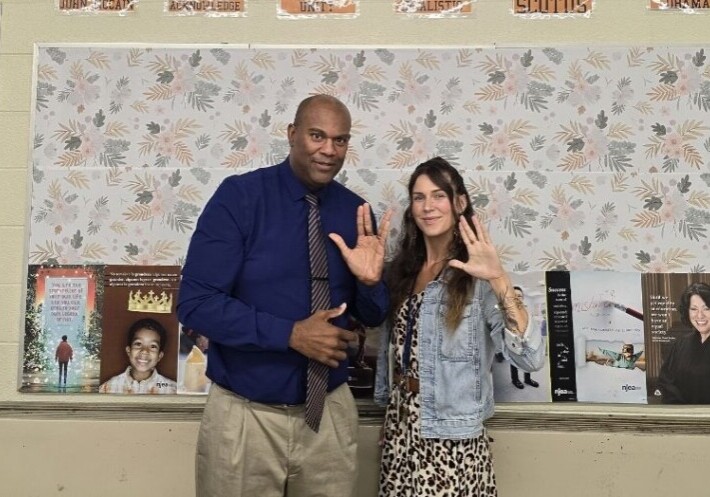
As I enter year 32 in education, it is important to me not only to survive but to thrive. Co-teaching can be a challenging task due to numerous variables. With the many different types of noises impacting the public education experience, we must remember that the students must come first, and we must maximize our time with them. Rachel Healy is my classroom partner in our U.S. history classes at Hackensack High School. She has been teaching for nine years, and we have been working together for four years. We feel our collaboration has been very successful and can be used as a model for others interested in co-teaching.
While there is no perfect way to do anything in the field of education, we have put together five essential principles that work for us in our classroom. These principles are communication, professional respect, procedures and consistency, community building and academic strategies. Over the past three school years, we have applied these principles and have seen strong academic, social and behavioral success.
Communication
One of the most important factors in our success has been solid and frequent communication. We have found that it turns a classroom into one unified learning community.
Rachel and I meet every morning prior to the first bell to recap what went on previously and to anticipate what we may expect for the coming days. These brief meetings help us set the stage for things that cannot be foreseen in our lesson plan. We make this time available for peace of mind and to execute the daily lessons to the best of our abilities. The time that we spend meeting makes our classroom experience much easier and more rewarding for us and the students.
It is not uncommon for Rachel and me to text or call each other multiple times a day. These mini-communications keep us up to date in real time. Sometimes unexpected things happen between classes or even during classes that must be discussed.
In addition, we have a co-teacher-only Google Classroom page where we can take notes, send messages and collect resources.
One of the most important things that we do to encourage communication is that we welcome open and honest feedback from each other. That includes the good, the bad and the ugly. But that is only possible when it is closely tied with professional respect.
Professional respect
Rachel and I have found that when both educators value each other’s strengths, students gain twice the support. We value each other’s expertise, and we lean on those abilities when appropriate. We understand that our roles and responsibilities can change depending on the lesson and the level of expertise each one of us has on a given subject.
We always attempt to include each other’s skillsets in everything we do. There may be different levels depending on the subject, but there is always input.
Procedures and consistency
In our experience, clear procedures and consistent routines create the structure that helps every student feel secure and ready to learn.
The procedures that are unique to our classroom are posted on the walls around the room. We send the procedures to each student, parent and guardian electronically, as needed. As co-teachers, we monitor these procedures together and we are in mutual agreement on how they will be enforced and who, if either of us, will play the lead role for each procedure.
Consistency helps keep our classes well-organized and sets realistic expectations for our students and the teachers. The establishment of a flow helps keep our students on task and limits behavioral issues.
Community building
A strong classroom community isn’t built in a day. It’s built every day, through trust, respect and shared learning.
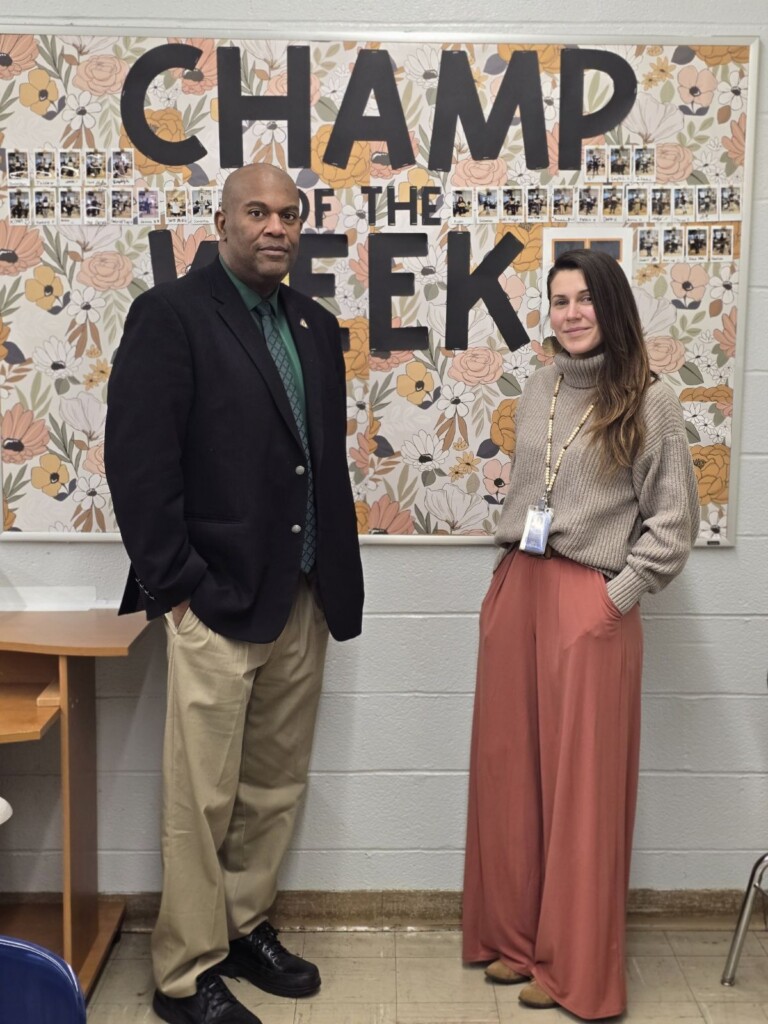
Each first day of a new school week, generally a Monday, we take about seven minutes to recap the prior week. We discuss the class goals we achieved the previous week and we honor a single student with a student of the week, award based on a criteria shared with the students. There is a small ceremony, and we honor the champion of the week with a certificate and a championship belt that the student can display in class until the next champion is crowned. A picture of each champion is placed on the wall of champions for the entire year. Most of our students want this award, but some of our students need this award.
We know that one way to build community inside the classroom is to involve the parents in positive ways. What we have named a “call of goodwill” is a phone call to the parent or guardian of a student that expresses our goodwill towards them and their student. We talk about how great the student is doing and how much we appreciate the parental involvement in the learning process.
We make it a habit to applaud and cheer for each other. We do this to acknowledge the good things and the effort that teachers and students put into the day. This small gesture is a great asset to our community and has helped us build the culture we want in our classroom.
Finally, we bring an element of joy to our classroom every day. The students can feel our energy, and that energy is often contagious.
Academic strategies
In our classrooms, we embrace the philosophy of two teachers, one team to ensure that the needs of both general education and special education students are met. This approach is grounded in the six core models of co‑teaching, which allow us to adapt instruction to different contexts and student needs. At times, one teacher may lead instruction while the other observes, gathering valuable insights into student progress and classroom dynamics. In other situations, one teacher takes the lead while the other assists, providing targeted support to individuals or small groups. We also employ station teaching, where students rotate through different learning activities led by each teacher, and parallel teaching, which allows us to divide the class into smaller groups for more personalized instruction. Alternative teaching provides opportunities for one teacher to work intensively with a small group while the other continues with the larger class, and team teaching enables both educators to share responsibility for delivering lessons together in a seamless, collaborative manner.
Beyond co‑teaching models, we integrate the principles of Universal Design for Learning (UDL) to ensure that every student has multiple ways to engage with material and demonstrate understanding. Lessons are designed to incorporate text, visuals, video, oral discussion, written work and digital tools, maximizing accessibility and expression for all learners.
We emphasize modeling and provide clear, step‑by‑step instructions so that expectations are transparent and achievable. Consistent routines and classroom norms further support student success by creating a stable and predictable learning environment.
Finally, we make thoughtful use of technology, leveraging digital platforms and tools to enhance instruction, foster engagement and prepare students with the skills they need to thrive in a modern, connected world.
There are no right or wrong answers to co-teaching, but after years of collaboration, this is what works for us. While some things are out of our hands, like scheduling, common planning time and room selection, we try our best to work with the situation at hand. Ultimately, the dynamic between co-teachers is what will make or break the team’s ability to maximize the classroom experience. I am very fortunate to have been teamed up with such an amazing partner in Rachel.
NJEA offers professional development in co-teaching. If you’d like to learn more, contact Dawn Howlen, associate director for Professional Development and Instructional Issues, at dhowlen@njea.org.
Rodney Lane is a special education teacher in the Hackensack School District. He also serves as an NJEA Communications and Professional Development and Instructional Issues consultant. He can be reached at rlane@njea.org.