

Hudson County Community College Professional Association negotiates award-winning contract
By Michael J. Ferlise
When you think of contract negotiations, do you envision an armored Russell Crowe defiantly entering the Colosseum as the enslaved Maximus Decimus Meridius in a life and death struggle for his freedom and the liberation of Rome under the oppressive Emperor Commodus? My suspicion is you do.
It is not an unwarranted vision given common assumptions that management and labor relations are naturally opposed to each other and fraught with hostile conflicts. In fact, all too many of us in the labor movement tirelessly and at times heroically confront abysmal circumstances and dishearteningly harsh relations with their administrations.
Since 2018, with an insurgent union leadership and then a new college president, Hudson County Community College has stood firmly and proudly outside this adversarial narrative. Many of our notable collective bargaining achievements, recognized by two Jim George Collective Bargaining Awards during these years, were possible because of a shared commitment by our association and a reform-minded college administration to work together to address and resolve important and complex institutional problems in a mutually beneficial manner. Though it has not always been easy, we have maintained a commitment to collaboration.
The Hudson County Community College Professional Association (PA) represents slightly more than 90 full-time faculty, which, as of our 2025-2028 contract, includes nursing and temporary full-time faculty. We were thrilled and honored to be the 2025 Jim George Collective Bargaining Award recipients. The award not only recognizes and celebrates the success of our settlements but also affirms the value and advantages of the collaborative and non-adversarial approaches we and our college administration have pursued.
2025 negotiations and preparations
Preparations for bargaining began in early October 2024 by forming various working groups and ad hoc committees to survey PA members for their preferred contractual items and priorities. The committees also gathered economic data and relevant contracts and legislation to aid in drafting proposals.
Although we relied on the solid guidance of our highly capable and responsive NJEA UniServ Representative, Maury Koffman, we remained principally committed to self-determination – conducting our own research, drafting more than 40 proposals, and leading our team’s negotiations.
Our hard-working and outstanding negotiation team included Lauren Drew, Sean Egan, Karen Hosick, Heather Connors and me. We provide the membership with regular updates and feedback and formed several joint taskforces and work groups with members of the administration to address the terms and conditions of the following proposals:
- An accelerated tenure clock application,
- Student mentoring,
- Technology and distance learning,
- New clinical coordination positions in radiography and medical assisting, and
- The inclusion of nursing faculty and temporary full-time faculty as new unit members.
While clearly defining and limiting faculty responsibilities, many of these proposals increased compensation as additional voluntary assignments. Some of these joint ventures were formed a year or more in advance of our actual negotiations, allowing the teams to craft better agreements whose terms and conditions were more thoroughly developed. Nearly all were lengthy and detailed proposals of high quality. The majority sailed through our negotiation sessions with little or no debate since they had already received the union’s and administration’s stamps of approval.
Bargaining challenges
We faced our fair share of challenges as we entered negotiations in Spring 2025. A great deal of financial uncertainty and political anxiety cascaded down from the state to the county and into the college’s administration and negotiation team in response to the Trump reelection.
Additional changes in the County and County Executive’s office, which had previously been supportive of our college, resulted in a sudden and unexpected removal of HCCC’s long-serving chair and vice-chair of the board of trustees. The threat of additional turnover loomed, leaving the association uncertain as to the new board’s position on our negotiations and the extent to which they would support our goal of financial parity with similar public institutions.
We also faced a burgeoning revolt by a contingent of faculty who adamantly opposed our intention to include nursing lecturers into the unit as full-time tenure-track faculty while also honoring their current salaries that were comparatively higher than non-nursing faculty. The nurses were the last of the lecturers, so categorically eliminating the lecturer position from our institution was a high priority for our team.
In addition, our agreement would allow the college to offer newly hired nurses significantly higher starting salaries than new non-nursing faculty due to their greater market value and the department’s troubling inability to retain nurse lecturers as employees. We believed this put upward pressure on faculty salaries in general. Our rebellious colleagues saw it as deeply unfair and, worse, an obstacle to ratification of an agreement.
The county was expected to pull back its maximum budgetary increase to our college to 2%. With cautious anticipation, the administration offered us a meager wage increase of 3.25%, 3%, 3% for each year of a three-year contract. Following upon the heels of our two previous and highly favorable settlements and our members’ expectations for parity, my negotiation team refused to present such paltry terms to our members, which we knew they would not ratify.
Ratification, we decided, would require a more creative response and viable alternatives.
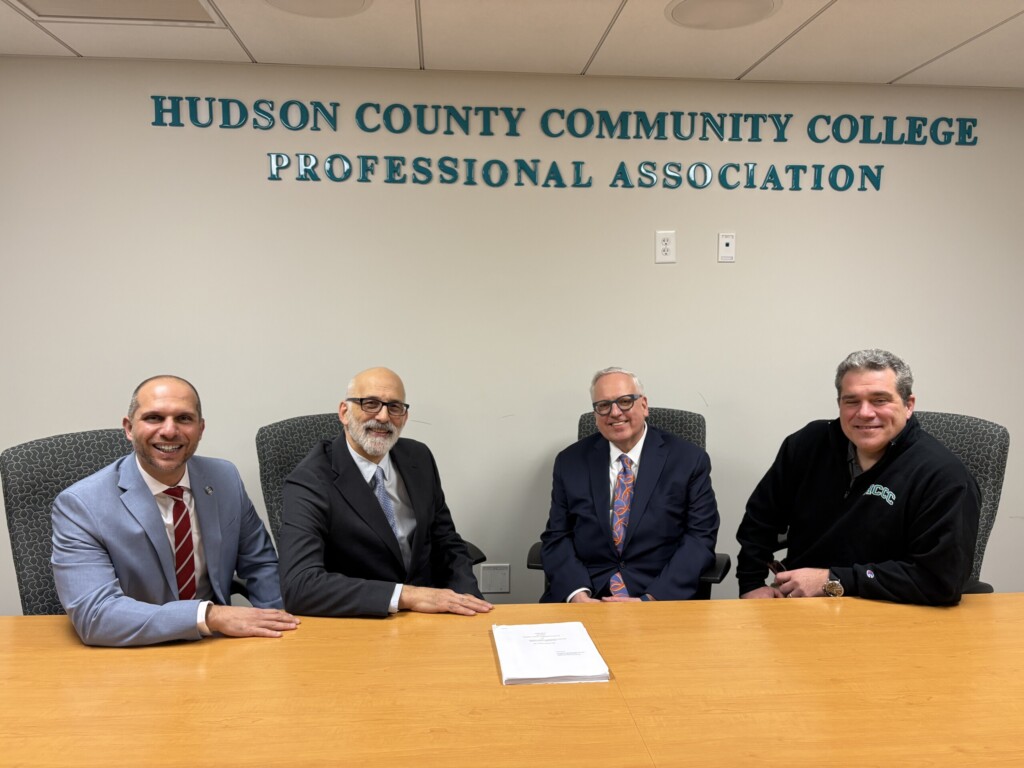
Dr. Christopher Reber and HCCC negotiating team chair Dr. Nicholas Chiaravalloti sit in the HCCCPA office.
New strategy and alternative proposals
In response to faculty opposition and the unacceptable salary offer, our negotiation team reworked our proposal while I held a series of productive sidebar discussions with Nicholas Chiaravalloti, head of the administration’s negotiation team, to work out a satisfactory alternative. Both teams eventually settled on the addition of varied criteria that would increase nursing and non-nursing faculty salaries based on degree/certification/credential attainment, years of service, as well as rank requirements. Increases may take place concurrently and therefore “stacked” as increments to the base.
We also agreed to a historic, first-time inclusion of a salary guide based on a 15-year/step model to replace our previous “30 Year Hybrid Parity Model” that allowed only a one-time salary adjustment for years of service. Faculty now reach maximums faster and their minimum salary ranges have been considerably increased for each of their four ranks. Instructor starting salaries, for example, increase 9.09% (from the previous $55,000 to $60,000); 15.38% increase for Assistant Professor (from $60,000 to $69,266); 15.40% increase for Associate Professor (from $65,000 to $75,013) and a 14.13% increase for Full Professor (from $75,000 to $85,599).
Implementation of the guide included the addition of $100,000 by the college for one-time equity adjustments that lifted minimums for newly hired instructors and helped ameliorate previous wage inequities for faculty serving 25 years or more. The PA agreed to trade our meager longevity increments – that were not added to our base salaries – to fund the guide.
The new wage increase amounts are significant. While the annual base wage increase for each member of the bargaining unit remains a flat 3.25%, 3.0% and 3.0% for each year of the agreement, the above-mentioned additions will increase our members’ base wages by a 12.4% total over the life of this agreement. For example, from Fall 2024 to Spring 2028 (year three of the contract), some members will realize an increase of their base salary from $72,265 to $96,144, a 27% increase, and $89,494 to $108,505, a 21% increase.
It is worth noting that these amounts do not include two separate $2,000 pay increases faculty now receive for their degree attainments, which we estimate will add another 1.15% to the base wage increase of 3.25% in year one. About a third of our members will benefit from them in the first year. And 21 members – about a quarter of our membership – will have their salary increased by more than $10,000 over the course of the contract. For members on-guide, the average year 1 salary increase is 6.2%.
Cooperative approaches can pose challenges
I want to be careful not to idealize or mislead when sharing our generally positive experience at HCCC or in evaluating the promise of non-adversarial approaches. Cooperative approaches can pose challenges and limits. A great deal of thought, effort and trust is required of them, and processes can easily break down despite both sides’ commitment. Even when parties agree with it in principle, collaboration can be difficult to define or stick to in practice, and the rules that govern such efforts can be equally difficult to agree on. Similarly, familiar adversarial tactics and mindsets are easy to fall back on, whether intentional or not.
Nor do I want to dismiss the importance of the real structural differences in power that exist between faculty and administration and the limit it may pose to what’s possible for labor. This, however, raises larger political and legislative issues.
Nonetheless, I believe our HCCC experience and Jim George recognition demonstrate that productive and meaningful alternatives to the adversarial model are possible and fruitful. Seizing opportunities to work in partnership with a willing administration, if not actively initiating such possibilities with them, offer real advances that further build and strengthen our unions.
Michael J. Ferlise is the president of the Hudson County Community College Professional Association. He may be reached at mferlise@hccc.edu.