
By Alan Davson
Alan Davson is a digital media instructor in Paterson Public Schools. He can be reached at alanpdavson@gmail.com.
Anyone who has visited my class knows how much I love words. I talk about them so much that most people assume I must be an English teacher. In reality, I teach digital media. But long before I learned the term content-area literacy, I was quietly building a personal mission: to infuse as much vocabulary awareness and language development into my classroom as possible.
This mission grew from something I observed again and again. My students were bright, creative, and expressive in conversation, but when they encountered text—whether directions, informational articles, or project-based instructions—they stumbled on unfamiliar vocabulary. A single unknown word could derail them. Many would try to push through by sounding out syllables, but once they realized they didn’t understand what they had just read, the frustration set in. Others avoided reading altogether, feeling embarrassed or assuming the text was “too hard.” The pattern was painfully familiar across grade levels and subject areas.
Over time, I realized something deeper was happening: students were struggling not just with reading but with language access itself. They lacked the words to articulate their challenges, describe their thinking, or ask for help with precision. Without vocabulary, they didn’t just struggle academically—they struggled socially and emotionally. They couldn’t name what was bothering them. They couldn’t negotiate conflict. They couldn’t express misunderstanding without feeling ashamed. This “language barrier,” as I began calling it, created far more academic and behavioral obstacles than I initially realized.
I started with the most common solution: vocabulary lists. For every unfamiliar term we encountered, I wrote it on the word wall. When inappropriate or overly simplistic slang crept into class discussions, I offered students precise, eloquent alternatives. We played vocabulary charades and quick verbal games to reinforce new words. And while these efforts helped incrementally, something was still missing. Students could memorize definitions, but memorization did not translate into long-term understanding or flexible use. They needed a way to unlock words, not just store them.
That’s when morphology entered the picture—at first accidentally.
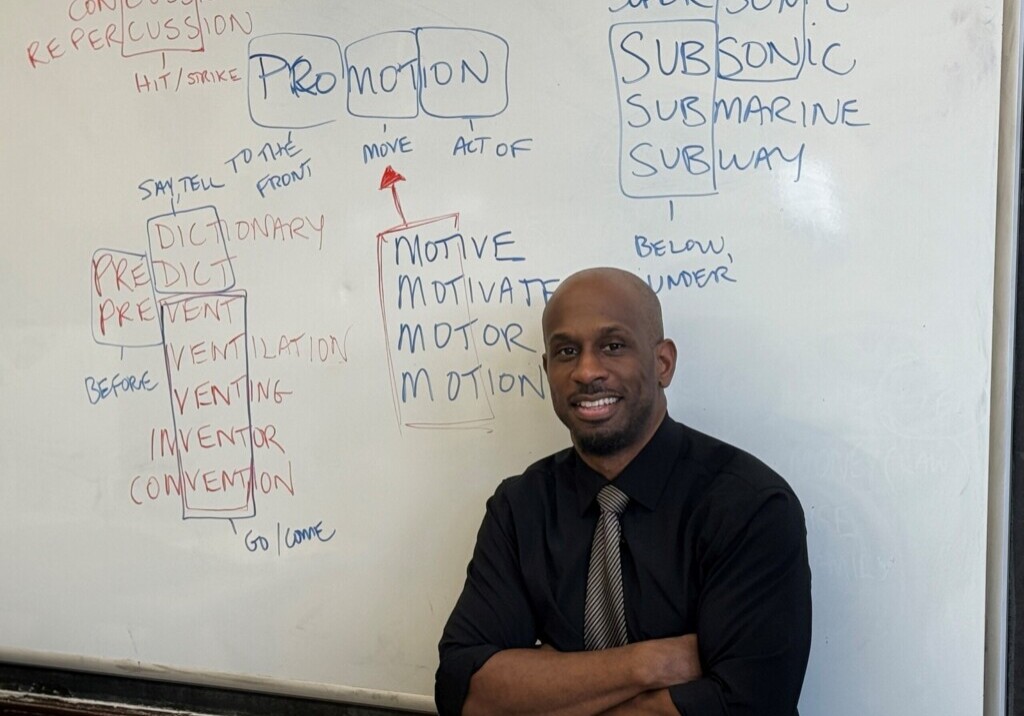
One day, while a student struggled with the word transport, I wrote trans on the board, then port. I asked what other words contained those chunks. Students shouted out transfer, transgender, transform, portable, import, and export. As we made connections across content areas and personal experiences, the energy in the room changed. Students began asking for more of these breakdowns, and I started calling them “word breaks.”
Over time, I developed a consistent structure for these word breaks. The routine became simple, repeatable, and highly engaging for learners of all levels. The structure looks like this:
1. Isolate the morphemes.
We begin by breaking the word into meaningful parts—prefixes, roots, and suffixes.
2. Use the word family to infer the meaning of the first morpheme.
Instead of giving students a definition, we construct a small “word family” of familiar words that share the same morpheme. Students look at this group and make a hypothesis:
“What do these words have in common? What idea connects them?”
For example, with trans, students might think of transform, translate, and transit. They infer that trans has something to do with “across,” “change,” or “movement.”
3. Repeat the process with remaining morphemes, expanding into word networks.
If a word has multiple meaningful parts, we repeat the process. Sometimes this expands into a larger “word network” that crosses subjects—science, math, health, social studies.
These networks naturally support students in making interdisciplinary connections.
4. Create a preliminary or “crude” understanding of the whole word.
Before consulting any formal definition, students blend the meanings of the morphemes into a functional guess.
For example, with promotion, students may combine pro- (“forward”) and -motion (“move”) to approximate “to move forward.”
5. Reveal the dictionary definition and compare.
Finally, we look at the dictionary meaning. Students notice where their reasoning aligns, where it diverges, and what nuances the formal definition adds. This comparison strengthens comprehension and establishes confidence—they learn that they can often deduce meaning independently.
I had no idea how powerful this routine would become. Students started requesting word breaks daily. They jumped at the opportunity to decode unfamiliar terms. Light bulbs went off—not just for them but for me as well. What I expected to be a simple vocabulary support tool quickly became a doorway into history, culture, science, philosophy, and grammar. We explored why English adopted certain words, how meanings shifted over time, and why specific morphemes appear in academic language more than conversational speech.
Often, these conversations took over the entire class period, but the payoff was so strong that time felt secondary. Students were genuinely curious. They wanted to know more. They asked deeper questions. And perhaps most importantly, they developed strategies to approach unfamiliar language independently.
As word breaks became a regular routine, I began refining them so that any teacher in any subject area could adopt the approach. The process requires no specialized training—just a willingness to slow down and examine the internal structure of a word. The more teachers I spoke with, the more convinced I became that morphology should be part of everyday instruction, not just ELA classrooms.
However, one concern kept resurfacing: while my enthusiasm naturally fueled engagement, I didn’t want a strategy that depended on having a charismatic or highly animated instructor to succeed. I wanted something that worked because of the structure, not because of the personality delivering it. That realization became one of the reasons I eventually transformed the routine into a game. A game could provide built-in engagement, fairness, competition, and curiosity without requiring an instructor to perform or “sell” the activity every day.
During the COVID-19 quarantine, as I explored ways to keep students engaged remotely, I began experimenting with turning morphemes into cards and testing different rule sets. After many revisions and prototypes, SAYWORD! emerged—not as a commercial pursuit, but as the natural evolution of the word break routine my students had grown to love. The game captured everything that made our discussions powerful: the analysis, the reasoning, the surprises, and the collaborative discovery.
When we returned to in-person instruction, I introduced SAYWORD! cautiously, unsure whether the same energy would translate. To my surprise, the students were instantly enthusiastic. They debated word constructions, challenged each other’s reasoning, pulled from morphemes they learned months earlier, and built complex word networks without prompting. The classroom became a space where academic vocabulary, social-emotional learning, and authentic collaboration blended seamlessly.
Still, I wanted to ensure these activities aligned with formal literacy standards. When I revisited the Common Core State Standards, I discovered explicit guidance encouraging the study of roots, affixes, and word origins as early as kindergarten. This affirmed that our routine was not just engaging—it was pedagogically sound.
As SAYWORD! quietly made its way into more classrooms, something unexpected happened. Teachers began sharing it with colleagues, families took it home, and friends brought it to gatherings. When the game started reaching students and educators in Canada, Nigeria, and the United Kingdom, I was genuinely humbled. What began as an attempt to support my own students had somehow traveled to learners around the world. The reach was far beyond anything I had imagined, and it deepened my appreciation for how universal the struggle—and joy—of learning vocabulary can be.
Today, the word break routine remains the heart of my instructional practice. SAYWORD! emerged from it, but the routine itself is what transformed my classroom. By teaching students how words work—how they are built, how they connect, and how their histories shape meaning—I watched learners reclaim language as something they could control rather than something that controlled them.
My hope is that any teacher reading this feels empowered to try a word break tomorrow. Start with one word from your lesson. Break it apart. Build a small word family. Ask students what the parts could mean. Let them reason through it. Let curiosity lead the discussion. You may be surprised by the depth of connections your students make and the confidence they show when they realize they can unlock unfamiliar language.
For educators who would like examples of the routine, downloadable templates, or models of word families and networks, I’ve posted resources at saywordgame.com. Whether you adapt the structure for your subject area, use it as a warm-up, or explore the materials at your own pace, I hope the practice brings the same spark of engagement to your students that it brought to mine.