Athletic Trainers' Society of NJ (ATSNJ) is one of NJEA’s many affiliated groups. Learn more about our affiliated groups here.
NJEA members:
- Find your NJEA UniServ office here.
- Sign in to to njea.org to download your local association contract from the Member Dashboard.
Not an NJEA member yet? Learn about joining NJEA here.
Information for Athletic Trainers
#1: Make sure you have your Board-approved job description

-
If you don’t have it, just ask. Your union can help!
-
The job description should have a date on it. (Don’t be surprised if your job description is very old.)
-
The job description should provide a general outline of duties and responsibilities. (If your job description is outdated, see your union for assistance.)
-
Qualifications for the role may be included.
-
Availability and attendance at school athletic events may be detailed within.
-
The phrase, “any other duties assigned by administration” ONLY GOES SO FAR AND CAN BE PROBLEMATIC!
-
Evaluation criteria for your position should derive from the job description for the position and relate directly to each of the tasks described. (As such, the same evaluation tool should be applied to staff members who share similar job responsibilities.)
#4: What is pensionable?
From the Employers’ Pensions and Benefits Administration Manual: Creditable Compensation
Creditable compensation consists of pay that meets all the following criteria:
- Pay for performance of duties required of a TPAF-covered position;
- Pay received in a regular paycheck, not in a lump-sum payment;
- Pay not specifically listed as extra compensation or as not being creditable;
- Pay received in a similar manner by everyone else in a similar situation; and
- Pay that is included in base salary from the first day it is paid.
A stipend may be considered as credible compensation and subject to pension deductibles for retirement credit, if it:
- Is included as part of the petitioner’s regular payroll check; and
- Represents duties not addressed in base compensation that are integral to the effective functioning of the member’s contracted position.
The creditable compensation rule does not prohibit the inclusion of longevity, holiday pay, or education pay in creditable salary. These items can be included if the payments are made as a part of each paycheck for all employees in the same collective bargaining agreement from the time; they first receive the compensation.
Note that a school district employee may need to produce a notarized statement that any pay is pensionable and conforms with the statutes and rules governing TPAF. Relevance of contractual provisions may need to be submitted to the Division of Pensions and Benefits as well.
Questions about this information? Reach out to your NJEA UniServ field representative. Find him or her here.
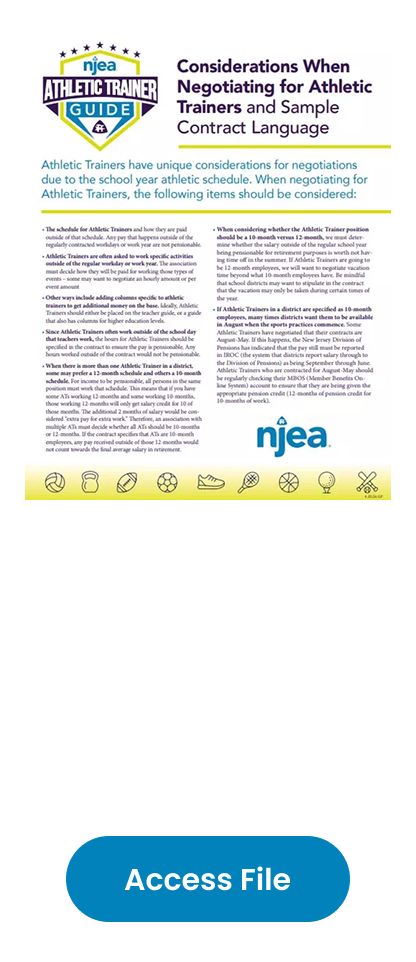
Find more information on our publication, Athletic Trainers Guide: collective bargaining considerations for local associations. Download it below.