

by Marybeth Beichert
This past June, members from NJEA and NJREA joined forces with other public sector unions to rally for affordable health care. The timing was no accident considering that public workers across the state were bracing themselves for another year of skyrocketing insurance premium. The rally, along with the lobby days that followed, served as a powerful reminder to Governor Sherrill and state lawmakers that legislative action is needed to rein in the out-of-control, unaffordable costs of health care that are crippling public employees’ financial security.
There are many factors that contribute to the increase in health care costs:
- A fee-for-service healthcare system that incentivizes volume over quality of care
- Lack of focus on primary care
- Expensive innovations in medical care and prescription drugs
- Lack of transparency in healthcare and prescription drug costs
- An overly complex healthcare system that necessitates high spending on third parties unrelated to the actual delivery of healthcare (accounting for 25% of healthcare spending)
- School districts negotiating separately for insurance rates rather than leveraging collective purchasing power
- Using the School Employees’ Health Benefit Program (SEHBP) as a safety net when a district has high health insurance costs, thereby driving up rates.
However, the most significant factor contributing to the growth in health care spending is not the utilization of health care, but the high cost of hospital services. According to Zack Cooper, Director of the Health Care Affordability Lab at Yale, hospital prices are the leading driver of the 320% increase in insurance premiums that Americans have experienced over the past 25 years. Since 2000, prices at hospitals have grown faster than prices in any other sector of the economy.
One of the reasons hospitals can charge the prices they do is because of their size and leveraging power. In New Jersey (and across the country) hospital mergers are a common occurrence. Over the past decade, major healthcare systems have been created due to mergers and acquisitions changing the entire landscape of healthcare providers.
In 2015, Robert Wood Johnson Health System and Saint Barnabas Health merged to form RWJBarnabas Health. Around the same time, Hackensack University Health Network and Meridian Health combined to create Hackensack Meridian Health. Similar consolidation has occurred across the state with systems such as Virtua Health, Cooper University Health Care, and Atlantic Health. As a result, it is more than likely that many NJEA members and their families have received care from one of these large health systems at some point, supporting the research that shows that 70% of U.S. hospitals are now system affiliated.
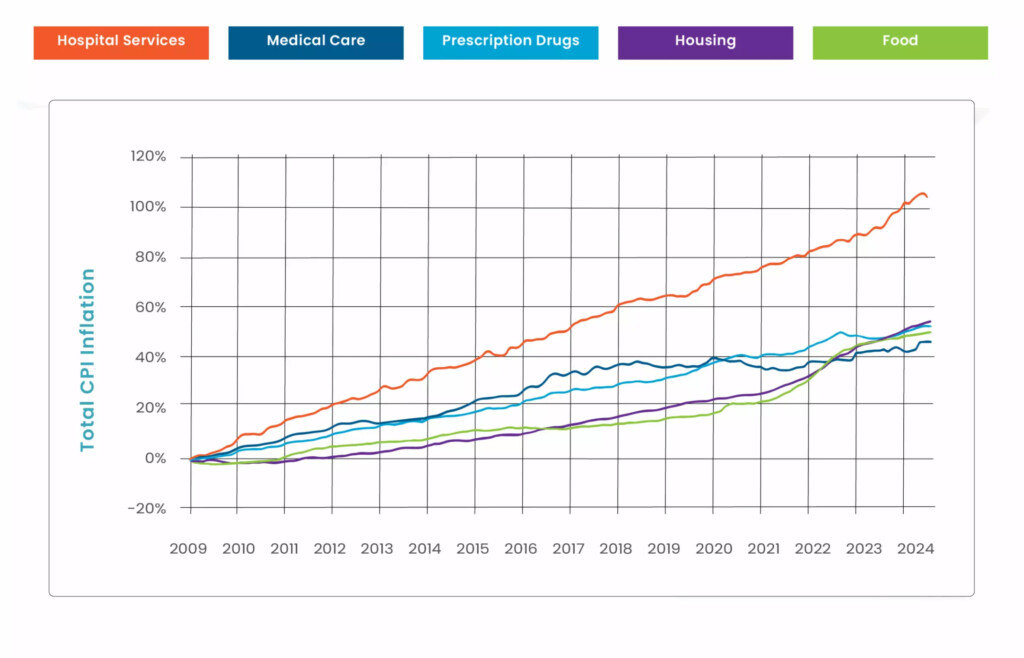
Consolidation costs the consumer
Hospital consolidation doesn’t necessarily mean more efficient operations or better patient care. However, it does allow for greater bargaining power when negotiating with private insurers, especially since there is little standardization of hospital prices to begin with. As hospitals grow larger through mergers and acquisitions, they can command higher prices for inpatient and outpatient services. These increased prices contribute to higher profit margins for hospital systems but more expensive health care costs for employers, workers and their families.
The mergers aren’t exclusive to hospitals as these healthcare systems also acquire surgical centers, urgent care providers and physician practices. This reduces local competition by allowing healthcare systems to negotiate higher reimbursement rates with health insurers. A 2024 analysis by the American Medical Association (AMA) found that only 42.2% of physicians were in physician-owned, independent private practice, giving them less autonomy and less control over clinical decisions and patient care.
Possible solutions
Unless hospital costs are addressed through legislative oversight, public employees across the state, including NJEA members, will continue to face unprecedented insurance rate hikes that will surely strain school districts’ ability to fund programs and provide job security.
Addressing these high costs is only one part of the solution, but it is a necessary step toward reducing overall healthcare costs.
Two critical healthcare affordability bills are currently awaiting committee hearings in the Legislature. Moving these bills forward is essential to making healthcare more affordable for public employees.
A5285/S4438 the Public School Employees’ Health Benefits Trust Act is legislation that focuses on controlling costs at their source, improving transparency and creating a more stable and sustainable system for the long term.
A1729/S3012 – The Health Care Accountability Law is legislation that would provide a clear pathway for the State to address the healthcare affordability crisis through the creation of an independent commission that would hold the healthcare industry accountable and enforce the state’s cost and price growth benchmarks. This bill is being championed by The New Jersey Coalition for Affordable Hospitals, labor unions (including NJEA), healthcare providers and advocacy groups committed to using collective power to lower hospital prices.
NJEA members and the public employee union members who stood together in June must do everything in their power to ensure that these bills advance through the Senate and Assembly. There will be well-funded opponents who want to stop the bills because they believe that public employees should bear the brunt of the cost. NJEA members must prove them wrong.
Marybeth Beichert is an associate director in the Communications Division.