
by Josh Langenberger
At Howell Township Middle School South, learning doesn’t just happen inside a classroom—it flourishes in our students. My colleagues and I have helped shape a school culture where student-led inquiry, hands-on science and community partnerships thrive in harmony. To achieve these goals, I’ve relied on the support of outside organizations and the Parent Teacher Organization (PTO).
My colleagues and I share our passion for environmental learning with students. For example, outside of school, I’m a gardener and beekeeper, and those passions find their way into my teaching. With the help of supportive colleagues, students, families and organizations, we’ve transformed our school’s outdoor space into a living classroom—what I call a “learnscape.” It’s a place where science is alive, rooted in real-world challenges and reaching toward the stars.
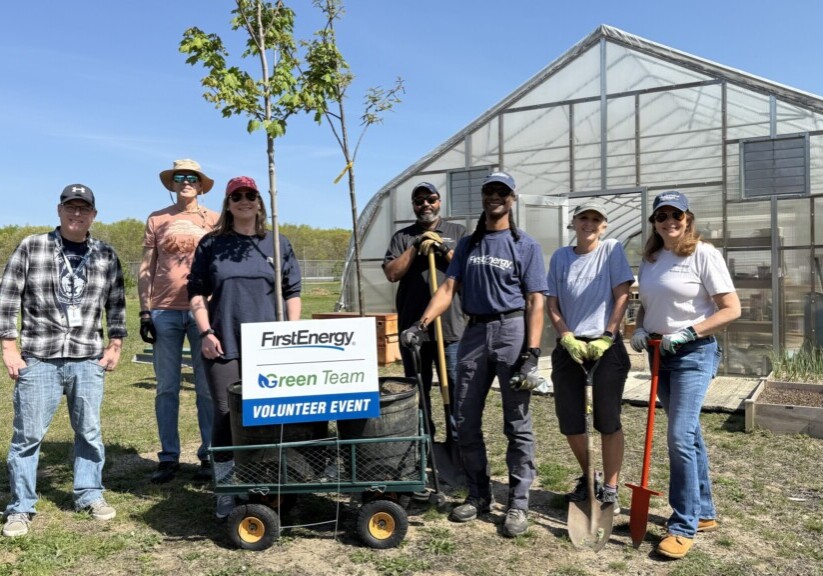
From a NASA Artemis I Moon Tree to a sustainable food forest, a greenhouse funded by the NJEA Frederick L. Hipp Foundation for Excellence in Education and supported by the PTO, and a pollinator garden built by an Eagle Scout, the Middle School South campus is now a living, breathing learning lab—and a model for what education can look like when rooted in purpose.
NASA Moon Tree: A living legacy from lunar orbit
After completing a competitive national application process, I was thrilled when our school was selected by NASA to receive one of only a few hundred Artemis I Moon Tree saplings distributed across the United States. These remarkable trees were cultivated from seeds that traveled around the moon aboard the Artemis I mission, returning to Earth as part of NASA’s initiative to inspire the next generation of scientists, explorers and environmental stewards. Our sapling, a sweet gum tree is a living, breathing connection between space science and Earth-based education. The Moon Tree is more than a science lesson, it’s a symbol. It reminds students that they are part of a much larger story, one that spans ecosystems, generations and galaxies.
The food forest: A system that feeds minds and bodies
Thanks to a Sustainable Jersey grant funded by FirstEnergy, Middle School South established a diverse food forest just steps away from the Moon Tree. In collaboration with the Howell Green Team and the Shade Tree Commission, more than 30 fruit trees including apple, pear, plum and peach, were planted to create an edible landscape that students care for year-round. This space is more than a garden. It’s a living lab where students explore permaculture, climate resilience and food justice while donating fresh produce to local food pantries.
Greenhouse growth: Supported by a grant and the PTO
One of my many accomplishments was securing a $5,000 grant from the Hipp Foundation for Excellence in Education, an award that turned a vision into reality. With additional support from our dedicated PTO, we constructed a fully functional greenhouse on campus that now stands as a hub of innovation and discovery.
The greenhouse offers students a chance to immerse themselves in hands-on learning all year long. They experiment with plant propagation, seasonal crop cycles and composting. Beyond just growing plants, we are integrating biology, engineering and sustainability in a truly interdisciplinary space by cultivating seedlings for the food forest, monitoring temperature and humidity sensors, or studying the impact of light and soil composition on growth. The greenhouse embodies what’s possible when you combine grant funding, community support and students’ enthusiasm. The greenhouse is not just a structure, it’s a living classroom that cultivates curiosity and stewardship in every season.
Pollinator garden: Built by scouts, sustained by students
The pollinator garden at Middle School South began as an Eagle Scout project led by former student Mason Weiss. Designed to support native pollinators like bees and butterflies, the garden was carefully planned with milkweed, flowering plants and herbs that create a vibrant, sustainable habitat. It is also a certified butterfly waystation and serves as a vital ecological addition to our campus, complementing the food forest and greenhouse by supporting the broader environmental system. These vibrant gardens serve as hands-on learning zones where students study ecosystems, plant reproduction and environmental interdependence.
Powered by partnership: Growing together
In April 2025, I received another Hipp Foundation grant, called Seed to Sanctuary, to expand the school’s pollinator gardens and diversify the habitats available for native pollinators. This grant builds on the school’s mission to support biodiversity and enhance ecological education. The success of these outdoor learning spaces is deeply rooted in community support. Two champions of environmental learning work, Andy Valdes, a Monmouth County master gardener, and Lisa Doud, chairperson of the Howell Green Team, have been instrumental in securing additional grant funding and educational support to grow these spaces thoughtfully and sustainably.
Science is about building connections between knowledge and compassion, between classrooms and communities, and between us and the planet. It’s about global stewardship and planting the kind of hope that grows into lasting change.

Branching out: A 10,000 trees campaign on campus
In 2025, our school launched an ambitious campaign to plant 10,000 trees across our expansive campus. This is an initiative rooted in our commitment to climate action, habitat restoration and environmental education. Made possible through a Sustainable Jersey for Schools grant written by fellow educator and NJEA member Danielle Gianelos, this project is being brought to life by our Eco-Action Club, led by NJEA member and educator Steve Milkowski.
We’re empowering students to lead environmental change, take ownership of their campus and reimagine what a sustainable school environment can look like. As students dig into the soil, educate their peers and track the growth of these trees, they are contributing to something far greater than themselves. I believe planting a tree you may never get to sit under is one of the purest forms of hope. It’s about investing in a future you may never see and trusting that your actions today can grow into lasting change.

Conclusion: a living legacy of learning
At Middle School South, the commitment isn’t just to planting trees, it’s to planting the seeds of leadership, sustainability and lifelong curiosity. With every Moon Tree, greenhouse seedling and student-planted sapling, the school is cultivating not just environmental knowledge, but a generation of change-makers. This journey proves that when educators, students and communities unite with purpose, what grows is more than a garden, it’s a legacy that reaches for the stars.
Educators interested in launching similar projects are encouraged to explore opportunities through the NJEA Hipp Foundation, Sustainable Jersey for Schools and NASA Artemis Education. With a clear vision and committed partners, your schoolyard can become a springboard for discovery and a legacy of learning.
Josh Langenberger is an environmental science teacher at Howell Middle School South in Monmouth County. He can be reached at jlangenberger@howell.k12.nj.us.
NJEA Hipp Foundation
Learn more about other Hipp grants and how to apply for an NJEA Hipp grant at njea.org/hipp. Applications are due March 1.
Sustainable Jersey for Schools
Learn about Sustainable Jersey for Schools’ mission and apply for a grant at sustainablejerseyschools.com.
NASA Artemis Education
Learn more about NASA’s resources for educators and enroll your students in the mission at nasa.gov/learning-resources/join-artemis.